
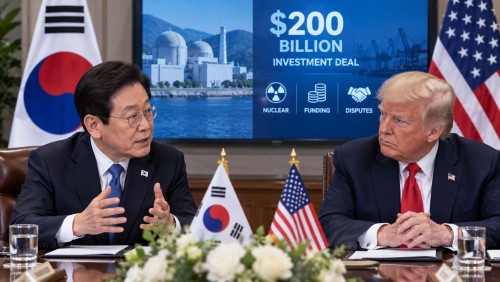
As South Korea aims to advance its $200 billion investment initiative in the United States, significant hurdles remain, particularly regarding nuclear projects and financial arrangements. The discussions between the two nations have been complicated by disagreements over nuclear reactor designs and the timeline for South Korea’s financial involvement, leaving the agreement’s future uncertain.
Central to the negotiations is a proposed plan to construct eight nuclear reactors in the U.S., with a mix of technology from both countries. Six reactors would employ Westinghouse’s AP1000 design, while two would incorporate South Korea’s APR1400 technology. However, resistance from U.S. officials and Westinghouse regarding the inclusion of the APR1400 design has stalled progress. Furthermore, South Korea is seeking a 15% to 20% stake in Westinghouse, including voting rights and a board seat, a move that Westinghouse is pushing to limit to less than 10% ownership.
Beyond nuclear technology, South Korea is contemplating participation in U.S. projects related to the processing of spent nuclear fuel and a proposed Alaska liquefied natural gas venture. Despite interest, concerns about construction costs and long-term profitability pose additional challenges.
Financial negotiations have also been contentious, with the U.S. requesting over $9 billion from South Korea by the end of the year. South Korea, on the other hand, had planned to start with a smaller investment in 2026, gradually increasing contributions from 2027. Disagreements persist over how to calculate investment returns and losses. While South Korea advocates for a system where profits from successful projects offset losses from others, the U.S. prefers a project-by-project accounting method. Under the current proposal, the U.S. would claim 90% of net profits after recovering principal and interest, a structure that has raised concerns in Seoul about financial exposure.
Despite these complexities, both governments continue to engage in dialogue to iron out the details of the investment framework. South Korea’s Industry Ministry has emphasized that the specifics of the projects, funding, and investment arrangements are still in development, indicating that negotiations remain active.