
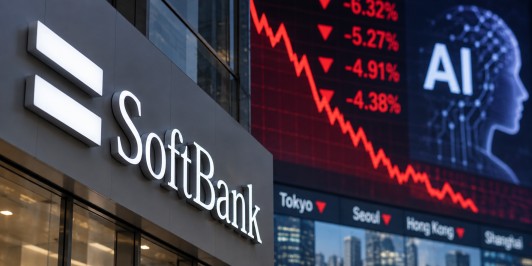
On Monday, Asian markets displayed mixed performances, with SoftBank Group, the renowned Japanese investment firm, experiencing a significant drop in its share value, plummeting over 10%. This decline was influenced by mounting apprehensions regarding the rapid advancement and safety protocols surrounding artificial intelligence. Notably, SoftBank is a prominent backer of OpenAI, and the call for enhanced safety measures and a more cautious approach in developing powerful AI systems has weighed heavily on technology stocks.
The ripple effect of these concerns was evident across the technology and semiconductor sector in Asia. In South Korea, SK Hynix saw its shares tumble by 5.3%, while Samsung Electronics experienced a 2.8% drop. Similarly, Japan’s Kioxia Holdings faced a significant downturn, with Tokyo Electron also sliding. This downturn in the AI sector comes amid an intensifying debate over potential regulatory measures that could be imposed on the development of advanced AI technologies due to safety concerns, as these systems become increasingly autonomous.
Meanwhile, the broader market reactions were varied. In South Korea, the Kospi index fell by 2.5%, whereas Japan’s Nikkei 225 experienced a 0.8% downturn. In contrast, Hong Kong’s Hang Seng and China’s Shanghai Composite indices managed to edge slightly upwards. The fluctuations in these markets reflect a broader sentiment of caution as investors assess the potential implications of future AI regulation alongside other economic factors.
Adding to the economic tensions, oil prices surged by over 3% amidst rising fears concerning global energy supplies. This was spurred by recent attacks targeting Saudi Arabia’s energy infrastructure, pushing Brent crude prices to approximately $108 a barrel, with US crude surpassing $103 a barrel. The spike in oil prices has intensified worries about inflationary pressures and the trajectory of global economic growth, particularly with investors keeping a close watch on the forthcoming interest-rate decision by the US Federal Reserve.
In the context of these global developments, US Treasury yields have maintained high levels, with the 10-year yield approaching 5%, exerting additional pressure on financial markets worldwide. Despite a positive close on Wall Street last Friday, where the S&P 500, Dow Jones, and Nasdaq all recorded gains after several days of losses, investor sentiment remains cautious. Market participants are keenly monitoring ongoing developments in the Middle East, fluctuating energy prices, interest rate trends, and the evolving discourse around AI regulation.