
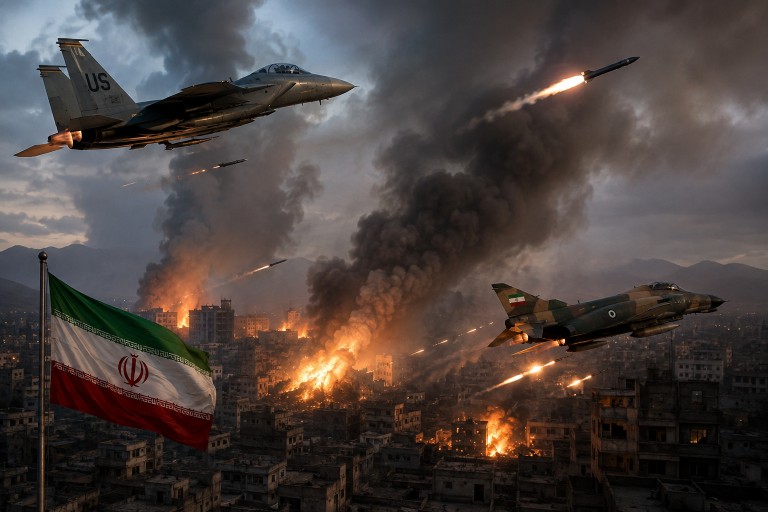
The exchange of airstrikes between the United States and Iran has reignited fears of a possible return to widespread conflict in the Middle East. The latest round of military actions involves the US targeting sites associated with Iran’s Islamic Revolutionary Guard Corps (IRGC). These strikes were reportedly in retaliation for Iran’s attempted assaults on commercial vessels in the Strait of Hormuz, as well as threats against American personnel in the region.
In response, Iran launched missile and drone attacks aimed at US interests in multiple countries, including Jordan, Bahrain, Kuwait, and Iraq. Jordanian military officials claimed they intercepted 10 ballistic missiles fired from Iran, although three missiles did land in sparsely populated areas. There were no immediate reports of casualties or direct impacts on the US military training facility located there. Moreover, Iran took responsibility for assaults on a US base near Erbil in Iraq, and missile and drone activities were noted in Kuwait, prompting air-raid alerts in Bahrain.
This escalation has intensified worries about the security of the Strait of Hormuz, a vital corridor for global oil transportation. The tensions have already led to a surge in oil prices, with Iran threatening to block oil exports from the Gulf should the US escalate its military or economic pressure. Iranian leaders have condemned the US military actions and have promised to retaliate, with President Masoud Pezeshkian indicating Tehran’s readiness to respond if Washington reneges on past commitments designed to prevent conflict.
Despite these warnings, the situation remains precarious, with both nations issuing stern cautions that further hostility could provoke harsher responses. US President Donald Trump has vowed a more aggressive course of action should Iran continue its attacks, while Iranian officials insist they will employ both military and diplomatic channels to safeguard their national interests.
The resurgence of direct military skirmishes comes after a period where the confrontation had largely shifted towards economic sanctions, blockades, and other non-military pressures. The recent military actions have sparked concerns that these diplomatic and economic efforts to manage the conflict might unravel, potentially leading the region back into sustained military engagement.