
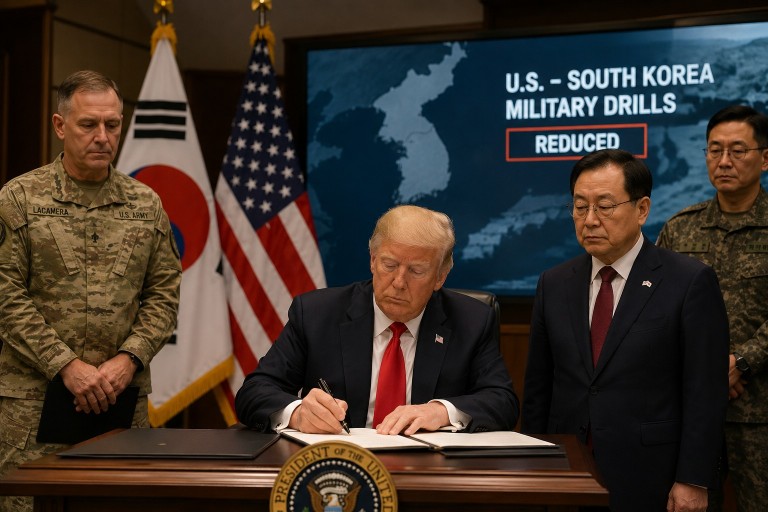
In a move reflecting his ongoing diplomatic strategy, US President Donald Trump has directed a significant reduction in joint military exercises with South Korea. Citing the high costs and the potential for sending the wrong message to North Korea, Trump linked the decision to his positive rapport with North Korean leader Kim Jong-un. The Ulchi Freedom Shield exercises, originally slated to commence on Monday and continue through August 27, were to involve approximately 18,000 South Korean troops, alongside US forces and personnel from various United Nations Command member states.
Though the exercises could not be canceled outright due to their imminent start, Trump instructed Defense Secretary Pete Hegseth to notably curtail US involvement. Despite this directive, South Korea’s defense ministry has stated that the drills will proceed as planned. The timing of this decision coincides with concerns from US and South Korean military officials that North Korea is accumulating valuable combat experience through its military alliance with Russia in the ongoing conflict in Ukraine.
North Korea has dispatched over 14,000 troops to bolster Russian forces, in addition to supplying artillery shells and ballistic missiles. Military experts suggest that North Korean forces are gaining insights into modern warfare technologies such as drones, GPS jamming, cyber warfare, and missile systems. In response to these developments, US military officials have adapted the exercises to address the new array of threats. They caution that the battlefield experience North Korean troops acquire in Ukraine could enhance Pyongyang’s military strength upon their return.
This decision marks another instance of Trump scaling back or suspending major US-South Korean military exercises in his pursuit of diplomacy with Kim Jong-un. The move has sparked renewed apprehension in Seoul regarding the future strength of the US-South Korea alliance and the region’s defense posture. South Korean analysts warn that curtailing the drills could undermine military readiness and deterrence capabilities, while yielding minimal diplomatic gains, given North Korea’s historical insistence on the complete cessation of such exercises.
North Korea has consistently labeled these exercises as rehearsals for offensive military actions and has threatened to take stronger military countermeasures. In a demonstration of defiance, Pyongyang has test-fired ballistic missiles in the lead-up to the drills. Despite President Trump’s decision to reduce US participation, South Korean authorities emphasize the importance of the joint exercises in preparing for the challenges posed by a progressively capable North Korean military.