
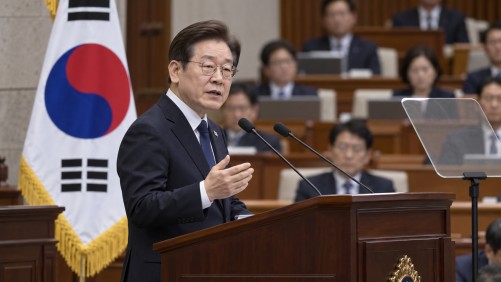
In a move to honor South Korea’s pivotal pro-democracy movements, President Lee Jae Myung has called for constitutional amendments that would formally recognize these historical events. Speaking at a ceremony in Busan on Friday, marking the 47th anniversary of the significant 1979 Buma uprising, Lee urged the National Assembly to initiate discussions on constitutional reform.
The Buma uprising, which began on October 16, 1979, at Pusan National University, saw students and citizens protest against the authoritarian regime of then-President Park Chung-hee. This movement is considered a crucial turning point in South Korea’s journey towards democracy. Lee emphasized that enshrining the Buma uprising and the May 1980 Gwangju Democratization Movement in the Constitution’s preamble would preserve the legacy of those who fought for democratic governance and the principle of popular sovereignty.
President Lee paid tribute to the bravery of the protesters who stood against authoritarian rule despite facing severe repression, noting their actions as key milestones in the nation’s democratic evolution. He also referenced subsequent movements, including the June 1987 Democracy Movement and modern demonstrations that have continued to defend democratic institutions in South Korea.
Lee has been a consistent advocate for revising the country’s Constitution, last amended in 1987, to better reflect the democratic values and struggles of its people. His proposals include changing the current presidential term limits from a single five-year term to two consecutive four-year terms. Although a previous amendment proposed by the ruling Democratic Party of Korea did not pass in May, Lee believes that recognizing these democratic movements might provide a foundation for renewed dialogue on constitutional reform.
During his address, President Lee called on lawmakers from both ruling and opposition parties to engage in public consultations to pursue meaningful and inclusive constitutional changes. He stressed the importance of ensuring that future generations do not have to endure sacrifices to safeguard democracy, advocating for a political system that remains accountable to the people.